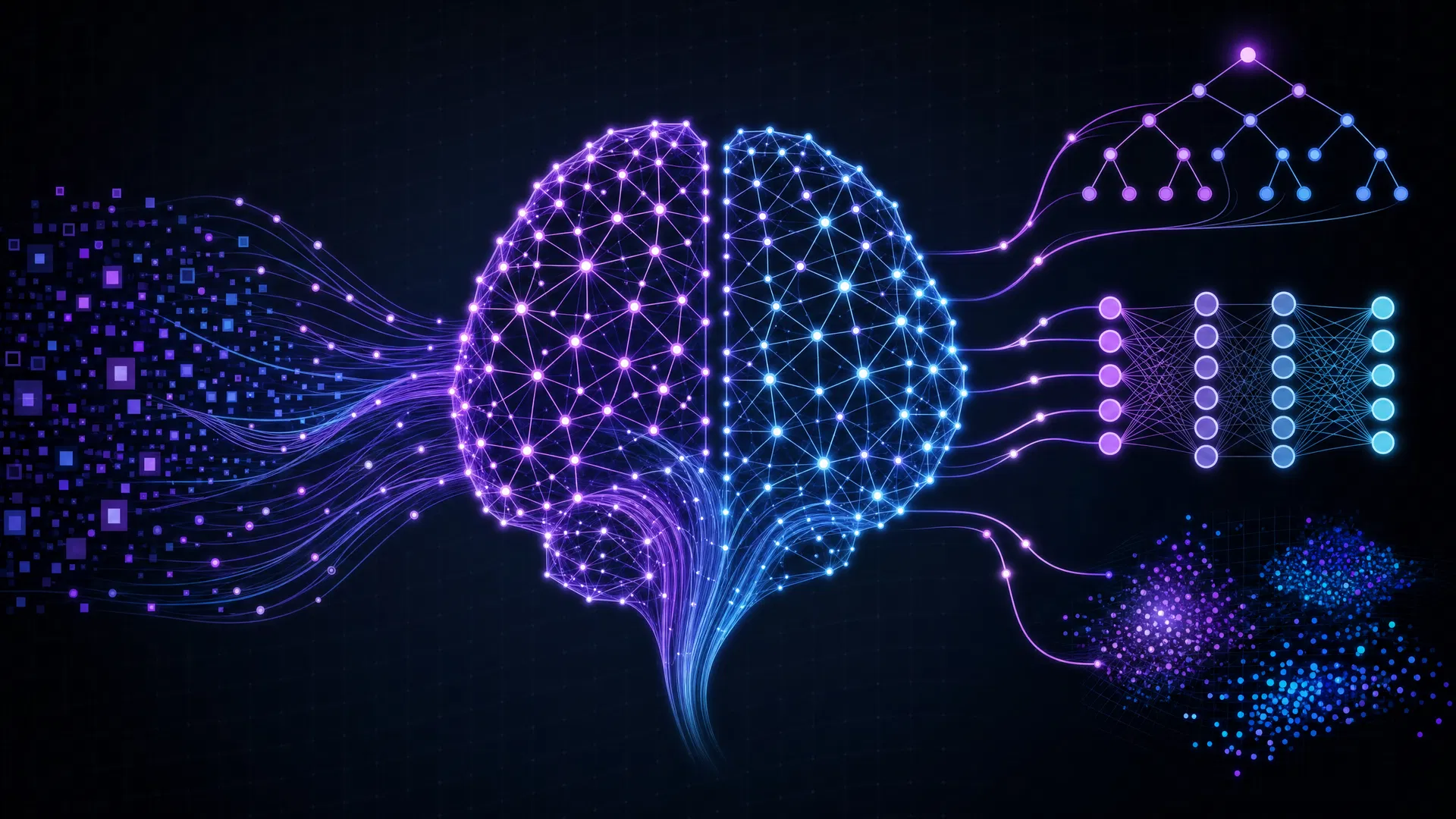
What Is Artificial Intelligence?
Explore the definition, history, and scope of AI — from early rule-based systems to modern deep learning.
Featured Video
— YouTube / IBM TechnologyWhat is Artificial Intelligence? — IBM Technology
Module Content
Artificial Intelligence (AI) refers to the development of computer systems capable of performing tasks that typically require human intelligence. These tasks include understanding language, recognizing patterns, making decisions, and solving problems.
The concept of AI dates back to the 1950s, when mathematician Alan Turing proposed the famous "Turing Test" — a benchmark for machine intelligence. Early AI systems relied on hand-coded rules, but modern AI uses statistical learning from vast datasets.
Three Types of AI
Narrow AI (Weak AI) is designed for a specific task — like playing chess, translating languages, or recognizing faces. This is the AI we interact with today. General AI (Strong AI) would perform any intellectual task a human can — this remains theoretical. Superintelligent AI would surpass human intelligence across all domains — a concept explored in science fiction and long-term research.
How Modern AI Works
Today's most powerful AI systems are built on machine learning — algorithms that improve automatically through experience. A subset called deep learning uses neural networks with many layers to process complex data like images, audio, and text. Large Language Models (LLMs) like GPT-4 are trained on trillions of words to understand and generate human language.
Understanding what AI is — and what it isn't — is the essential first step in your learning journey.
Real-World Example
AI in Your Daily Life
Every time you unlock your phone with Face ID, get a movie recommendation on Netflix, or ask Siri a question — you're interacting with AI. These systems learn from data to make predictions and decisions that feel surprisingly human.
AI Tools in This Module
Key Takeaways
- AI is the simulation of human intelligence in machines
- Modern AI is powered by machine learning and neural networks
- AI systems learn from data rather than being explicitly programmed
- Narrow AI excels at specific tasks; General AI remains theoretical