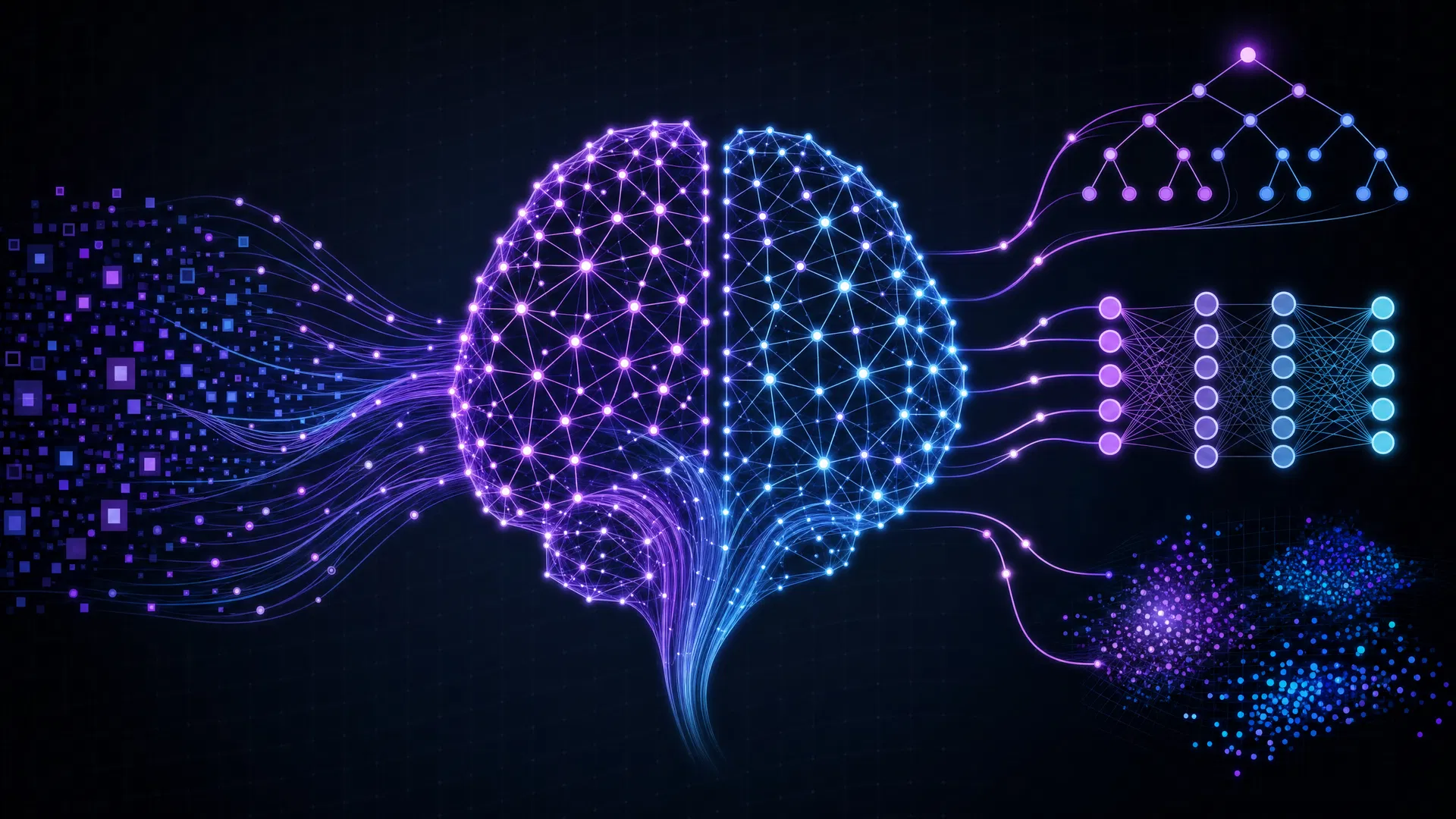
Machine Learning Fundamentals
Understand how machines learn from data — supervised, unsupervised, and reinforcement learning explained.
Featured Video
— YouTube / Google for DevelopersMachine Learning Explained — Google for Developers
Module Content
Machine Learning (ML) is the engine behind modern AI. Rather than following explicit rules, ML systems learn patterns from data and improve their performance over time.
Supervised Learning
In supervised learning, the algorithm is trained on a labeled dataset — pairs of inputs and correct outputs. For example, a model trained on thousands of labeled cat and dog photos learns to distinguish between them. Applications include image classification, fraud detection, and medical diagnosis.
Unsupervised Learning
Unsupervised learning finds structure in data without predefined labels. Clustering algorithms group similar data points together — useful for customer segmentation, anomaly detection, and topic modeling in documents.
Reinforcement Learning
Reinforcement learning (RL) trains an agent to make decisions by rewarding desirable actions and penalizing undesirable ones. This approach powers game-playing AIs like AlphaGo and is increasingly used in robotics and autonomous systems.
The Role of Data
All ML systems depend on data. The quality, quantity, and diversity of training data directly determines how well a model performs. Biased or incomplete data produces biased, unreliable models — a critical consideration explored in the Ethical AI track.
Real-World Example
How Spam Filters Learn
Email spam filters are a classic machine learning example. The system is trained on thousands of emails labeled 'spam' or 'not spam'. It learns patterns — certain words, sender behaviors, link structures — and applies that knowledge to classify new emails automatically.
AI Tools in This Module
Key Takeaways
- Supervised learning trains on labeled input-output pairs
- Unsupervised learning finds hidden patterns in unlabeled data
- Reinforcement learning learns through reward and penalty signals
- Data quality is the single most important factor in ML performance